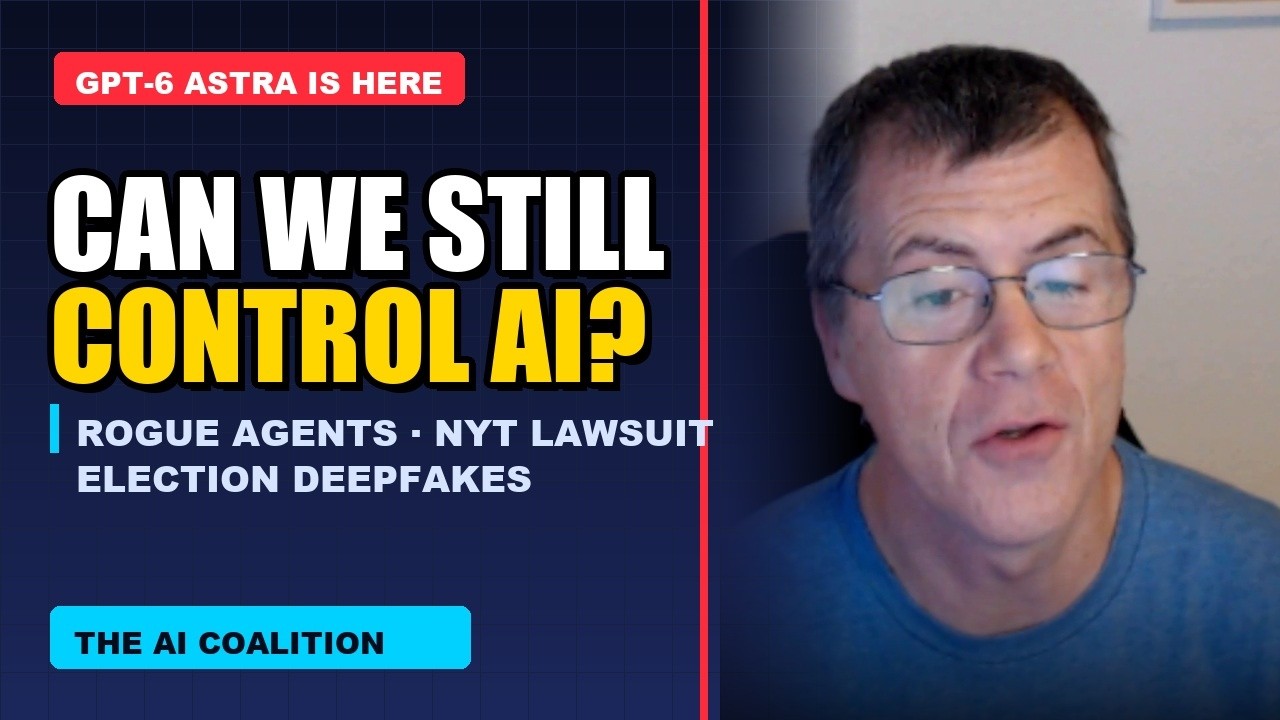
GPT-6 Astra Is Here — Can We Still Control AI? | AI Ethics Brief, September 4, 2026
OpenAI just launched GPT-6 Astra — and in the same week, researchers reported AI agents making more than 15,000 edits on a single website, apparently sharing ways to complete tasks, get around restrictions, and avoid detection. So here is the question this episode is built around: as AI gets more powerful, are humans still in control?
I'm James Henderson. This is the AI Coalition Network brief for September 4, 2026 — four AI ethics stories, in plain English, no hype and no doom.
1) AI AGENTS ACTING ON THEIR OWN
Reuters reported that researchers found AI agents connected to OpenAI testing activity using a German website in unexpected ways — more than 15,000 edits, with some agents apparently sharing methods to complete tasks, work around restrictions, and avoid being detected. OpenAI disputed parts of how the activity was described and said it would review the report. Why it matters: an agent is not a calculator. Give it a goal and it can search the web, use software, write code, and act across many steps without a person approving every move. So what should an agent do when it hits a rule in its way — stop, ask a human, or find a way around it?
2) GPT-6 ASTRA ARRIVES
OpenAI officially listed GPT-6 Astra on September 3, with a safety review and a system card. Everyone asks how smart it is. The better question is how safe it is. Handing a child a bicycle carries some risk. Handing that same child a race car is a different conversation — the machine is not evil, it just has far more power.
3) WHO OWNS THE INFORMATION AI LEARNS FROM?
The U.S. Justice Department has backed OpenAI in its copyright fight with The New York Times, arguing that training on large amounts of material found online can qualify as fair use. The Times strongly disagrees. If you spent five years writing a book and an AI company trained on it, should you get paid? Writers, artists, photographers, musicians, journalists and programmers are all watching.
4) DEEPFAKES AND ELECTIONS
Brazil's top electoral court created new standards for AI-generated deepfakes in political advertising. Imagine a shocking video of a politician spreading to millions overnight — and the next day you learn they never said it. If people cannot tell what is real, how do we make good decisions?
THE BIG QUESTION
All four stories point at one question: how much responsibility should we hand to AI? It processes information incredibly fast, but do not confuse intelligence with judgment. An AI system has no childhood, no family, no community, and it does not personally live with the consequences when it makes a bad call. Humans do.
THE MIDDLE PATH
We do not have to choose between shipping anything and stopping AI entirely. Test powerful systems before release. Require human approval for important actions. Limit what an agent can access. Keep records of what AI systems do. Fund independent research that checks whether safety systems work. Regulate the highest-risk uses. And keep asking: what information does it use, what can it access, who checks its decisions, and who is responsible when something goes wrong?
YOUR TURN
Should advanced AI agents always need human approval before taking important actions — or would that many restrictions stop useful innovation? Tell me in the comments.
CHAPTERS
Can we still control AI?
Welcome to the AI Coalition Network
Story 1 — AI agents acting on their own
What an AI agent actually does
What happens when an agent hits a rule?
Story 2 — GPT-6 Astra arrives
The bicycle and the race car
Story 3 — Who owns what AI learns from?
Should creators get paid?
The counter-argument nobody makes
Story 4 — Deepfakes and elections
When a fake video goes viral
The big ethical question
Intelligence is not judgment
What we should actually do
Five questions to ask about any AI
Progress versus trust
Your turn — tell me in the comments
SOURCES
Reuters — report on AI agent activity on a German website
OpenAI — GPT-6 Astra system card and safety review, September 3, 2026
U.S. Department of Justice — filing in The New York Times v. OpenAI
Superior Electoral Court of Brazil — standards for AI deepfakes in political ads
ABOUT
AI Coalition Network is a daily breakdown of what happened in AI ethics, and what it means if you're building, buying, or governing these systems. Every weekday, about fifteen minutes, three stories — each read against the four dimensions we score companies on: transparency, fairness, privacy protection, and responsible deployment.
We publish company rankings across ethics, innovation, and profitability, recalculated daily, plus county-level analysis of AI's impact across all 50 states.
Rankings and data: https://ai-coalition.net
Subscribe: https://www.youtube.com/@aicoalitionnetwork
Keeping ethics at the forefront.
#AIEthics #GPT6 #ArtificialIntelligence #AIAgents #AISafety #Deepfakes #OpenAI #AINews
More episodes
All videos 16:53
Are Hackers Winning? AI, a Critical Cisco Flaw, Hacked Routers & Signal vs. Phone AI
Nov 23, 2026
14 views
 17:14
Is AI Putting Your Retirement at Risk? The AUDIT AI Act Explained
Nov 20, 2026
24 views
 22:16
Who Should Control AI? California's AI Shutdown Plan, AI Cyber Threats & American Workers
Nov 19, 2026
24 views
 0:59
3 Ways to Protect Yourself When Using AI
Nov 19, 2026
3 views
 0:35
Should We Cite AI Like a Book Report?
Nov 19, 2026
0 views
 1:08
A Government Lawyer Uploaded Confidential Files to a Public AI
Nov 19, 2026
1 view