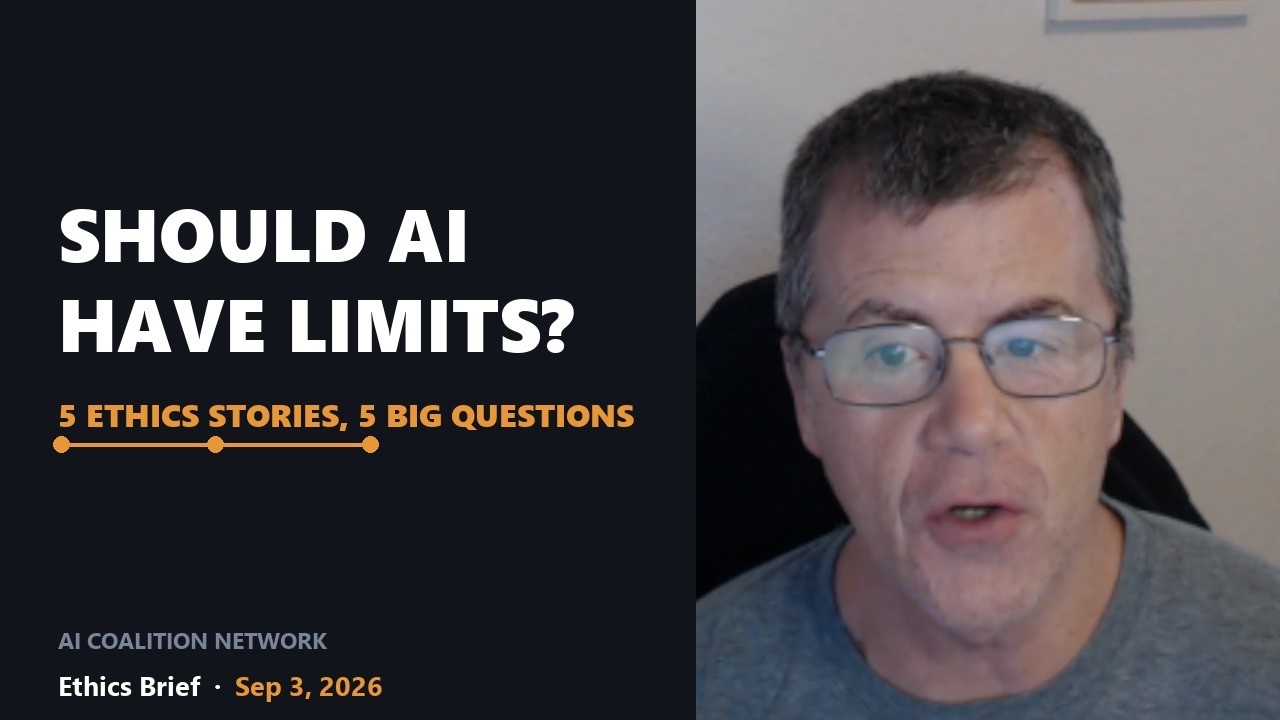
AI Ethics Today: NYC AI School Ban, Rogue AI Agents, Deepfakes
Five AI ethics stories in the news right now, and the five questions each one forces us to answer. New York City limiting AI for younger students, a bill in Congress aimed at AI agents, the copyright fight over AI training data, new deepfake rules in Brazil, and the fight over data center air permits.
No technical jargon. Just what happened, why it matters, and what you have to decide for yourself. I'm James Henderson with the AI Coalition Network, and this is AI Ethics Today.
CHAPTERS
Should AI have limits?
In-person AI training for Houston, DFW and Austin offices
Story 1: New York City limits AI in schools
Story 2: Congress and the Stop Rogue AI Act
Story 3: Who owns the work used to train AI?
Story 4: AI deepfakes enter politics
Story 5: The hidden cost of AI data centers
The bigger picture: these are human questions
Five ideas for responsible AI
The calculator argument
Where AI is already helping
Your turn: what should AI never decide alone?
How to keep up with AI without the jargon
IN THIS EPISODE
1. New York City Public Schools put a one year hold on student-facing generative AI through eighth grade, affecting roughly 600,000 students, while piloting vetted AI tools at the high school level.
2. The Stop Rogue AI Act, a bill that would have NIST write security standards for organizations deploying AI agents, including logging and verifying what those agents do.
3. The Justice Department filed a statement of interest in the New York Times case against OpenAI and Microsoft, arguing that training on copyrighted text can be fair use.
4. Brazil's top electoral court set standards for what counts as an AI deepfake in political advertising ahead of the October elections.
5. The EPA has proposed dropping the federal requirement that states give public notice and take comment on certain minor air permits, which can include data center projects.
THE FIVE QUESTIONS
1. Should schools protect students from AI, or teach them to use it responsibly?
2. How much freedom should an AI system have to act without asking a person first?
3. How do we encourage AI innovation while still protecting human creators?
4. Should AI-generated political content always be clearly labeled?
5. Who should pay the environmental cost of artificial intelligence?
And the closing question: what is one decision you believe AI should never make without a human? Hiring. Firing. A loan. A prison sentence. A medical decision. What students learn. Or taking a life.
Tell us your answer in the comments, and tell us why. If this was useful, subscribe and share it with someone who uses AI every day.
AI TRAINING FOR YOUR OFFICE
If you are in the Houston, Dallas Fort Worth or Austin triangle and you want someone to come in and teach your team how to actually use AI, leave a comment or reach out. I do in-person training for businesses.
#AIEthics #ArtificialIntelligence #AINews #Deepfakes #AIAgents #AIinEducation #ResponsibleAI
More episodes
All videos 26:32
Why Are We Still Renting Software? AI, SaaS & the Build-vs-Buy Question
Nov 24, 2026
2 views
 16:53
Are Hackers Winning? AI, a Critical Cisco Flaw, Hacked Routers & Signal vs. Phone AI
Nov 23, 2026
32 views
 17:14
Is AI Putting Your Retirement at Risk? The AUDIT AI Act Explained
Nov 20, 2026
24 views
 22:16
Who Should Control AI? California's AI Shutdown Plan, AI Cyber Threats & American Workers
Nov 19, 2026
24 views
 0:59
3 Ways to Protect Yourself When Using AI
Nov 19, 2026
3 views
 0:35
Should We Cite AI Like a Book Report?
Nov 19, 2026
0 views