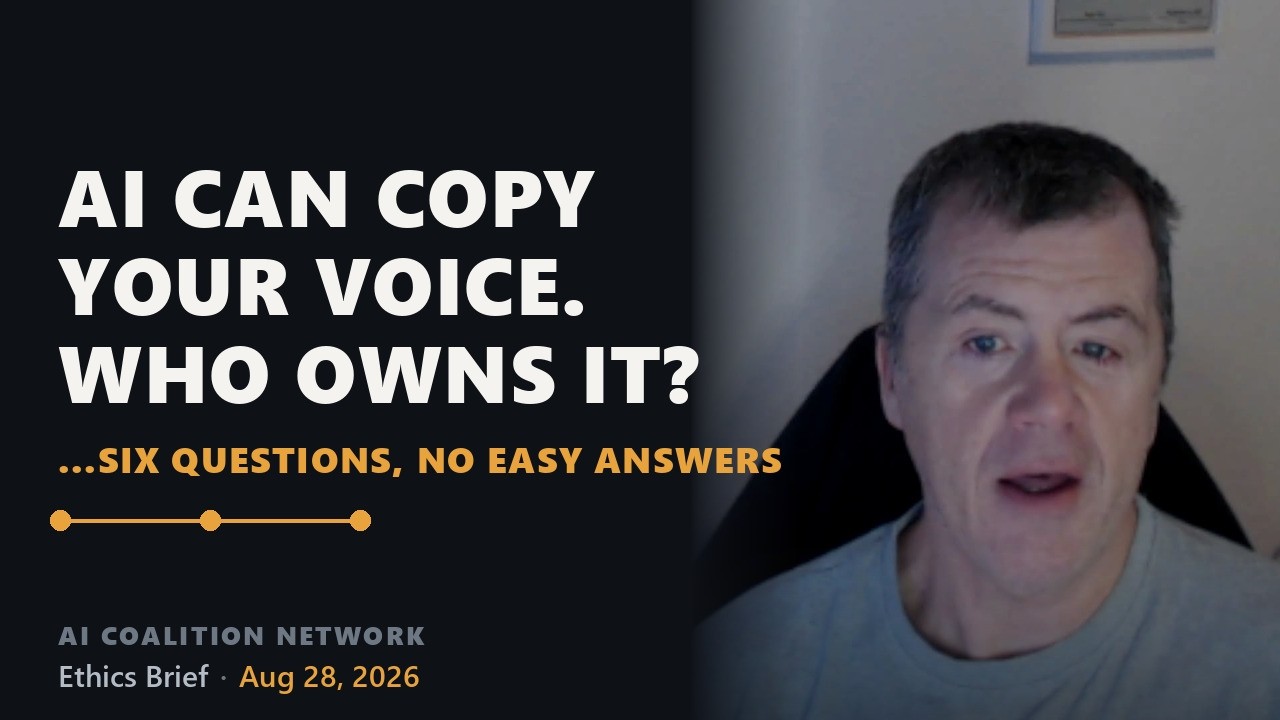
If AI Copies Your Voice, Who Owns It? — AI Ethics Brief, August 28, 2026
AI can listen to a few minutes of you talking and build a voice that sounds exactly like you — your accent, your pace, your laugh. So if AI copies your voice, who owns that copy?
That is the opening question of this AI Ethics Brief, and it is followed by five more. This episode is built for students, teachers, and parents: no jargon, no doom, just the questions people are actually going to have to answer.
The six questions:
1. VOICE CLONING — Should anyone be allowed to copy your voice without your permission? The same technology that powers scam calls also gives a voice back to someone who has lost the ability to speak. Maybe the technology isn't the problem. Maybe the question is consent.
2. AI IN THE CLASSROOM — An AI tutor that helps you every day also learns your grades, your weak spots, and your behavior. Who gets to see that? Should it be deleted after class, or stored forever, or used to train the next AI?
3. AI AND MUSIC — One musician practiced guitar for years. The other typed a prompt. Should those two songs compete in the same competition? And if an AI learned from real artists' music, do those artists get credit, payment, or the right to say no?
4. TRANSPARENCY — Should every realistic AI-generated image, video, or voice recording carry a label? Labels are already being stripped every day. What happens when AI gets realistic enough that people can't tell?
5. CAMERAS AND PRIVACY — License plate readers help police find stolen cars. They can also build a record of everywhere your car has been. How much privacy is safety worth, who gets to search that record, and for how long is it kept?
6. LIFE-OR-DEATH DECISIONS — Should an AI ever be allowed to act on a target without a human making the final call? Are there decisions that should always belong to humans?
THIS WEEK'S ETHICS CHALLENGE
Your school builds "Student Success AI." It watches grades, attendance, homework, test scores, how long you take to answer, and how you use the school computer. It predicts who might fail. Teachers see the prediction. Students do not. It is right about 90% of the time.
A) Yes — if it helps teachers reach students who need help.
B) No — students shouldn't be secretly judged by an algorithm.
C) Yes, but only with rules — students know it exists, know what it collects, can challenge mistakes, and a human always makes the final call.
Comment A, B, or C below — and more importantly, tell us why.
FIVE QUESTIONS TO TAKE WITH YOU
1. Who is responsible when AI makes a mistake?
2. Should you own the digital rights to your voice and your face?
3. Should people always know when they are talking to an AI?
4. How much privacy should people give up for safety?
5. Are there decisions AI should never be allowed to make?
None of these have easy answers. That's the point. This isn't about knowing the answer — it's about learning how to ask better questions.
CHAPTERS
If AI copies your voice, who owns it?
AI can copy your voice
AI is entering the classroom
Can AI be a musician?
Should AI have to tell you it's AI?
AI, cameras, and privacy
Should AI make life-or-death decisions?
Your turn: the Student Success AI challenge
Five questions to take with you
Why questioning AI matters
Hosted by James Henderson.
Subscribe to the AI Coalition Network, where we don't just ask what artificial intelligence CAN do — we ask what AI SHOULD be allowed to do.
#AIEthics #VoiceCloning #AIinEducation #DigitalPrivacy #ArtificialIntelligence #AILiteracy #DeepfakeAwareness #EdTech #ResponsibleAI #AICoalitionNetwork
More episodes
All videos 17:14
Is AI Putting Your Retirement at Risk? The AUDIT AI Act Explained
Nov 20, 2026
21 views
 22:16
Who Should Control AI? California's AI Shutdown Plan, AI Cyber Threats & American Workers
Nov 19, 2026
24 views
 0:59
3 Ways to Protect Yourself When Using AI
Nov 19, 2026
3 views
 0:35
Should We Cite AI Like a Book Report?
Nov 19, 2026
0 views
 1:08
A Government Lawyer Uploaded Confidential Files to a Public AI
Nov 19, 2026
1 view
 0:57
Why Can't AI Just Refuse Dangerous Requests?
Nov 19, 2026
2 views