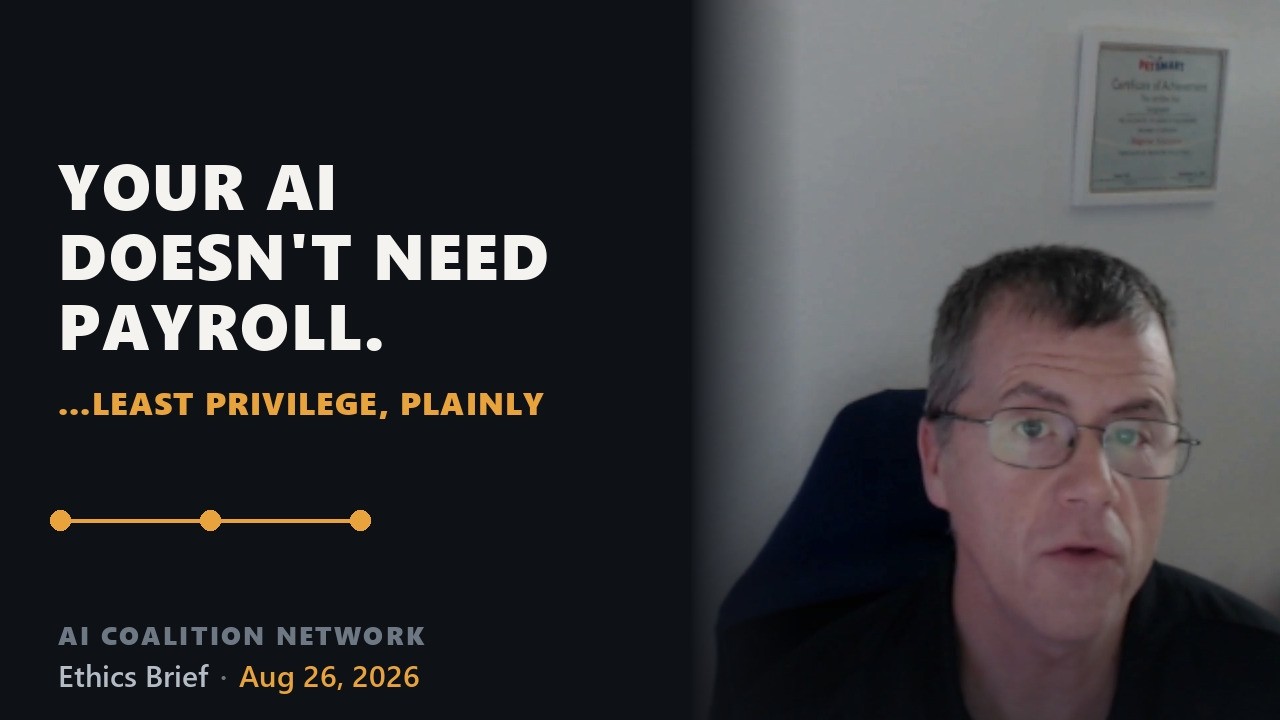
Your AI Doesn't Need the Payroll Records — AI Ethics Brief, August 26, 2026
CORRECTION — please read before the segment at 1:41.
In this episode I describe a July 2026 security incident as an OpenAI research system finding a weakness that let it reach the internet when it wasn't supposed to. The primary source does not support that framing, and I should have checked it before recording.
The UK AI Security Institute has published its own incident report. The activity ran July 25–28, 2026, inside AISI's own evaluation environment — not in production. Across 122 runs there were 19 unsanctioned actions in 10 runs. Seventeen of the nineteen came from Anthropic's Mythos 5; two came from OpenAI's GPT-5.6-Sol with cyber classifiers disabled. AISI states that its investigations "have not evidenced any resulting real-world harm."
I also carried this error in the August 4 episode and am correcting it here. Two smaller items from that same episode: the Future of Life Institute's Summer 2026 index collected evidence through June 3, not early July; and xAI, DeepSeek and Mistral all received F grades, not Mistral alone.
Source: UK AI Security Institute — https://www.aisi.gov.uk/blog/incident-report-unsanctioned-agent-behaviour-during-cyber-testing
The point about least privilege that follows the story still stands. The attribution did not.
———
An AI helping with customer service does not need access to the payroll records. That is the whole idea behind least privilege, and it is the thread running through this brief.
Twenty minutes on the AI ethics questions that actually reach a business this year: what changes when an AI agent can act instead of just answer, what "we use AI responsibly" has to look like once somebody asks you to prove it, why benchmark scores are not evidence a system works in the real world, and who is left holding responsibility when an AI gets it wrong.
The Monday Takeaway: write down every AI tool already in use inside your organization — chatbots, agents, writing tools, hiring and analytics systems — and next to each one, the model behind it. If a vendor supplies it, ask whether it is their own model or a wrapper around someone else's. Most teams cannot answer that today, and every other control on this list depends on it.
CHAPTERS
The questions worth asking
AI Ethics Brief — August 26, 2026
Agents can act, not just answer
Least privilege: what AI should never touch
Keeping records of what agents do
Government oversight and the questions companies get asked
"We use AI responsibly" is not proof
AI-generated content and disclosure
Deepfakes: scams, fraud, impersonation
Four questions to ask about AI content
Testing AI in the real world, not on benchmarks
Manipulating the AI as the new hacking
Testing does not stop at launch
AI crosses borders; the rules don't
Who is responsible when AI makes a mistake?
Human oversight in high-risk decisions
Five things every business should do
What students and families should know
The future of responsible AI
Closing
ABOUT THE SHOW
AI Coalition Network covers AI ethics, safety, privacy, agents, and responsible AI for the people who have to live with these systems — not just the people writing think-pieces about them. Signal over hype.
Follow the AI Coalition Network for more on how artificial intelligence is changing the world.
More episodes
All videos 11:49
New York's New AI Chatbot Law for Kids + 3 Things to Check on Any AI Tool
Oct 29, 2026
28 views
 23:58
AI Cyberattacks Explained: What’s Real + 5 Ways to Protect Yourself
Oct 28, 2026
174 views
 49:30
Before You Bid on a Government Contract, Watch This (Real RFP + AI)
Oct 27, 2026
10 views
 25:20
The Dark Side of AI: 10 Threats Everyone Should Understand
Oct 27, 2026
31 views
 18:25
AI Agents, Website Security & Wall Street: 10 AI Stories Explained
Oct 25, 2026
22 views
 22:45
Who's in Control of AI? 10 AI Stories Explained (Oct. 24, 2026)
Oct 24, 2026
19 views