Executive Summary
On October 6, 2026, the UK government accepted all 44 recommendations from the National Commission into the Regulation of AI in Healthcare. The event date and the government response’s publication date are both October 6. The Commission’s recommendations were published earlier, on September 10, 2026.
This is an important policy commitment, but it is not a new healthcare AI law or a completed regulatory system. Many details still depend on consultations, guidance, possible legal changes, funding, and an implementation roadmap promised for spring 2027. Draft guidance for managing planned changes to adaptive AI devices is targeted for December 2026.
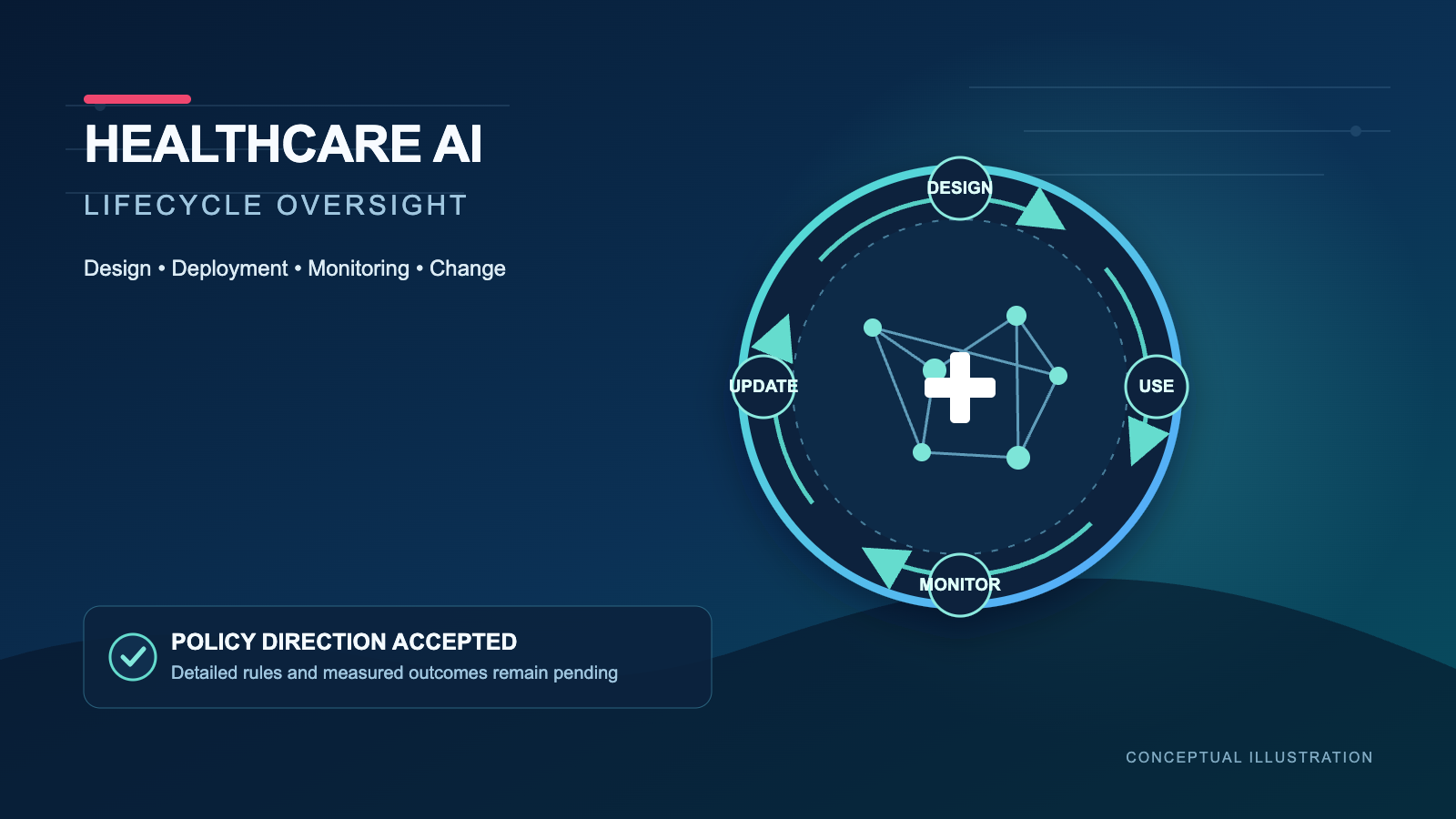
The proposed direction is to judge healthcare AI across its full lifecycle. That means looking not only at evidence before a product enters the market, but also at how it performs after deployment, after software updates, and in different hospitals or patient groups. The approach could support safer innovation and clearer routes to market. It could also create risk if earlier access is allowed without strong evidence, monitoring, stopping rules, cybersecurity, and redress.
No outcome evidence available as of October 7, 2026, shows that accepting the recommendations has improved safety, fairness, patient outcomes, clinician workload, investment, or time to market. Those outcomes remain unverified.
What Happened?
The UK Department of Health and Social Care and the Medicines and Healthcare products Regulatory Agency, known as the MHRA, published the government’s response on October 6, 2026. It accepted all 44 recommendations from an independent, non-statutory advisory commission.
“Accepted” is the key status word. It means the government agreed with the policy direction and set out an implementation program. It does not mean that every recommendation is in force. The response assigns future work to regulators, health departments, the National Health Service, and other bodies.
The government plans to consult by spring 2027 on how software and AI-enabled medical devices should be defined and classified. It also says secondary legislation will follow, but no final legal text or start date was provided in the reviewed material.
One concrete step did begin on October 6: applications opened for AI Airlock Phase 3. AI Airlock is a regulatory sandbox, meaning a controlled program used to test ideas and gather evidence. It is not certification, market approval, or proof that a participating product is safe. Its current focus includes post-market surveillance and lifecycle oversight.
Why This Matters
Healthcare AI can change after it is first reviewed. A model may be updated. The patients seen at one hospital may differ from those in its original test data. Local equipment, workflows, staff training, or data quality can affect performance. An upstream cloud service or general-purpose AI model may also change.
For these reasons, a one-time review may not answer every safety question. The UK’s planned approach would place more weight on evidence gathered throughout the product’s working life.
The stakes are high. A well-designed system could help clinicians, improve access, and detect problems sooner. A weak system could let uncertain products reach patients too early, hide poor results in smaller groups, or leave clinicians responsible for failures they could not control.
The decision also matters outside the UK. Companies selling clinical software or AI-enabled medical devices across the UK, European Union, and United States may face different rules in each market. That can improve local control, but it can also raise the cost of compliance.
How the Technology Works
Healthcare AI often uses a model trained on examples, such as medical images, health records, or measured signals. The model finds patterns and produces an output. That output might flag an image for review, estimate a risk, or support a clinical workflow. It does not remove the need to decide how the output should be used.
“Lifecycle oversight” means checking the system from design through retirement. Before deployment, reviewers may examine training data, test results, intended use, cybersecurity, and human factors. After deployment, manufacturers and healthcare providers may monitor errors, performance changes, incidents, updates, and differences between patient groups.
“Model drift” means performance changes over time because the data, population, workflow, or model has changed. A system that worked well in one setting may not work as well elsewhere. Monitoring can help find that change, but only if the data are reliable and someone has authority to act.
The government also plans draft guidance on Predetermined Change Control Plans. These plans would describe, in advance, the boundaries within which an adaptive AI device may change. The goal is to permit managed updates without treating every minor change as a completely new product. As of the research timestamp, the UK guidance was still pending and its final legal effect was unknown.
The Ethical Question
The central ethical question is how to give patients earlier access to useful AI without lowering the level of protection they deserve.
Innovation and safety do not have to be enemies. Better monitoring may allow useful products to improve while in service. Clearer rules may help responsible developers plan better tests. Yet moving some evidence collection into real-world use also moves some uncertainty closer to patients.
That trade-off is acceptable only if uncertainty is clear and safeguards are real. Patients should not carry hidden experimental risk. Clinicians should not become the default owners of failures caused by opaque design choices, poor data, or vendor-controlled updates. Developers, providers, regulators, and upstream technology suppliers need defined responsibilities.
Public support should not be overstated. The Commission described support for healthcare AI as conditional on safety, effectiveness, fairness, transparency, accountability, and meaningful human oversight. Its evidence program included several different methods. The reported engagement of more than 12,000 people was an aggregate count, not one representative national study. A separate call for evidence received 761 self-selected responses and should not be treated as a representative public survey.
Potential Benefits
Lifecycle oversight could identify performance decline, unsafe updates, local failures, and cybersecurity signals that a pre-market review might miss. Better device and version records could help teams understand which system affected a patient and when.
Clear classification and evidence expectations may also reduce uncertainty for developers and investors. Managed change plans could support faster, safer software updates. A staged pathway, if designed well, could allow supervised use while useful evidence is gathered.
Patients may benefit from clearer notice, better incident information, and workable routes to question a decision or seek redress. Monitoring across demographic groups could reveal unequal performance that a broad average hides.
These are intended benefits described or supported by the policy materials. They have not yet been demonstrated by the newly accepted framework.
Potential Risks
Staged access could expose patients to immature systems if minimum evidence, supervision, and stopping rules are weak. Monitoring after deployment cannot repair a poor decision to deploy when basic safety evidence is missing.
Surveillance can also fail. Data may be incomplete, inconsistent, or difficult to share. Too many alerts can overwhelm staff. A signal may appear without a clear threshold for pausing use, rolling back an update, or withdrawing a product.
Continuous monitoring may require more collection and linking of sensitive health data. The policy direction does not yet settle limits on purpose, retention, access, or secondary use. Strong privacy controls will be needed alongside safety monitoring.
Cybersecurity is another patient-safety issue. Connected devices, software updates, cloud systems, and upstream AI models create dependencies. The response promises lifecycle cybersecurity work, but final requirements for testing, vulnerability disclosure, patching, rollback, audit logs, and older devices remain unresolved.
Fairness is also uncertain. The government names children, women, ethnic minorities, and other underserved or underrepresented groups. However, final subgroup sample rules, performance thresholds, enforcement tests, and proof of reduced disparities do not yet exist.
Government Perspective
The government presents the package as a proportionate and coordinated way to support innovation while protecting patients. Its response links lifecycle evidence, post-market monitoring, traceability, patient communication, workforce readiness, and redress.
It plans a cross-system Programme Board that will meet quarterly. A roadmap promised for spring 2027 is expected to assign roles, timelines, and deliverables, followed by annual progress updates.
Existing law should not be overlooked. Great Britain already has post-market surveillance duties for medical devices that took effect on June 16, 2025. The new AI-specific proposals would build on and tailor that baseline. Northern Ireland has a distinct EU-derived medical-device system, so the territorial picture is not uniform.
The government’s position is an official policy commitment. Its claims about expected improvements should still be treated as projected benefits until measured results are available.
AI Industry / Research Perspective
Developers may welcome clearer product categories, predictable evidence rules, and a way to manage updates. AI Airlock Phase 3 may help regulators and companies study lifecycle methods in controlled settings. The program can use simulation, virtual environments, or shadow deployment, where outputs are not used for real patient decisions.
Researchers and assurance teams will need methods that can detect drift and subgroup differences without producing misleading signals. They will also need to separate a harmful model change from a change in local workflow, patient mix, or data quality.
Upstream suppliers matter too. A medical product may depend on a general-purpose model, cloud platform, or outside data service. The government is exploring information requirements about provenance, dependencies, risks, and controls. Exact disclosure duties, confidentiality protections, and update responsibilities are not yet operative.
Sandbox participation must not be presented as approval. Research activity can generate evidence, but it does not prove safety, clinical benefit, or regulatory compliance.
Business Impact
Medical-device and clinical-software companies should prepare for more lifecycle evidence, version tracking, post-market monitoring, cybersecurity work, and documentation of upstream dependencies. Healthcare providers may need stronger procurement terms, technical monitoring, incident reporting, and staff training.
Clearer rules could lower uncertainty and support investment. At the same time, new evidence and reporting duties could increase costs, especially for smaller companies. Rules should be strong enough to protect patients without becoming so complex that only dominant vendors can comply.
Multinational suppliers should watch for differences among Great Britain, Northern Ireland, the European Union, and the United States. The final cost and burden cannot be calculated until the UK publishes detailed guidance, legal changes, and the spring 2027 roadmap.
Consumer Impact
For patients and carers, the most important issues are safe performance, clear information, meaningful human review, privacy, and a practical route to challenge harm.
A patient may reasonably want to know whether AI played a material role in care, what the system was designed to do, and who remains responsible. Notice should be understandable, not buried in technical language. Choice or opt-out may be valuable in some settings, but the practical limits are not yet defined.
Better traceability and public incident information could make accountability easier. Yet transparency without action is not enough. Patients also need accessible complaints, correction, compensation, or other redress when something goes wrong. The final form of those arrangements remains uncertain.
What Happens Next?
The next near-term milestone is draft MHRA guidance on change-control plans, targeted for December 2026. A consultation on qualification and classification is planned by spring 2027.
The spring 2027 implementation roadmap will be a major test. It should explain who does what, when work is due, how it is funded, and which measures require guidance or law. It should also clarify staged access, evidence thresholds, enforcement, patient rights, cybersecurity, and responsibility across the supply chain.
AI Airlock Phase 3 will generate evidence, but useful evaluation will require public measures for both benefits and harms. Leaders should watch for results on safety, equity, patient outcomes, workload, speed, and market access—not only the number of projects or products entering a program.
AI Coalition Network Perspective
The UK has chosen a promising direction: regulate healthcare AI as a changing system rather than a fixed object. That approach can support innovation because it recognizes that software can improve. It can protect patients because it also recognizes that performance can decline.
The strength of the policy will depend on implementation. Earlier access should come with minimum evidence, clear supervision, pause and withdrawal triggers, secure update and rollback plans, and public reporting. Human oversight must give trained people real authority and enough time to use it.
Regulators should measure whether the framework works. Success means safer and more equitable care, useful innovation, clear responsibility, and workable redress. Acceptance of 44 recommendations is a starting point, not proof of those results.
Questions Leaders Should Ask
- Which rules are already in force, and which are only planned, exploratory, or in draft form?
- What evidence will be required before staged access and before full authorization?
- Who owns monitoring, and who can pause, roll back, or withdraw a system?
- How will performance be checked across hospitals and patient groups?
- What data will be collected, who may access it, and how long will it be kept?
- How will cybersecurity duties cover updates, upstream models, cloud services, and older devices?
- Who is responsible when harm involves a vendor, provider, clinician, or upstream supplier?
- Can patients understand AI’s role, challenge a decision, and obtain meaningful redress?
- Are regulators, providers, and clinicians funded and staffed for the added work?
- What public evidence will show whether safety, equity, access, and innovation actually improve?
Sources
- UK government response to the National Commission’s recommendations — Government source. Event date: 2026-10-06. Publication date: 2026-10-06. Status: official acceptance and implementation commitments; most detailed reforms remain pending.
- National Commission recommendations for a future regulatory framework — Government-hosted advisory report. Event date: 2026-09-10. Publication date: 2026-09-10. Status: non-statutory recommendations, not law.
- AI Airlock Phase 3 application — Government source. Event date: 2026-10-06, when applications opened. Publication date: 2026-10-06. Status: active sandbox and evidence program, not authorization or proof of safety.
- Research, engagement, and call-for-evidence findings — Government source. Evidence-gathering event period: 2025–2026. Publication date: 2026-06-11. Status: mixed-method engagement evidence; not one representative population study.
- Call for Evidence: Summary of Findings — Government report. Event period: 2025-12-19 through 2026-02-02. Publication date: 2026-06-11. Status: 761 self-selected responses; not a representative survey.
- Medical Devices (Post-market Surveillance Requirements) (Amendment) (Great Britain) Regulations 2024 — Legislation source. Instrument made: 2024-12-16. In-force event date: 2025-06-16. Source publication date: not established in the research package. Status: existing Great Britain law; Northern Ireland has a distinct regime.
- NHS review of digital clinical safety standards DCB0129 and DCB0160 — Standards source. Consultation closing event date: 2026-09-11. Cited page last edited: 2026-06-30. Status: existing standards remained active while under review at the research timestamp.
Source and uncertainty note: This draft relies on the validated research package and ethics analysis completed on 2026-10-07. Where those artifacts did not establish a publication date, the date is marked unknown rather than estimated. Future implementation and outcome claims remain unverified.