Executive Summary
On October 7, 2026, the Monetary Authority of Singapore (MAS) issued final Guidelines on Artificial Intelligence Risk Management for Financial Institutions. The event date and the publication date of the main official records are both October 7, 2026. The Guidelines are supervisory guidance. They are not a new statute, regulation, criminal rule, investigation, or enforcement action.
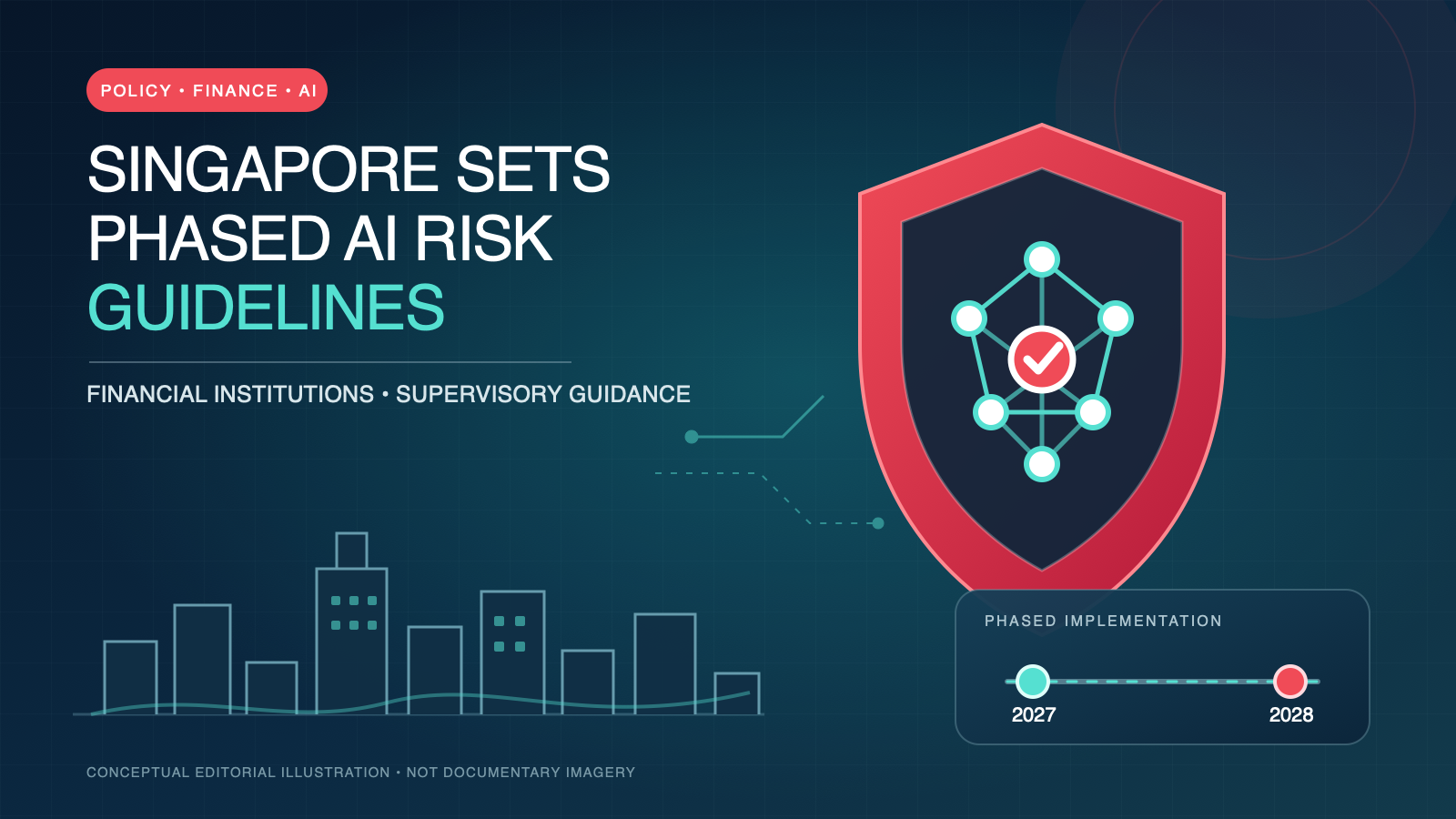
The framework asks MAS-regulated financial institutions to manage AI according to risk. It covers governance, AI inventories, risk ratings, testing, human oversight, customer impact, cybersecurity, monitoring, incidents, and third-party systems. Sections 3 and 4 apply from October 7, 2027. Sections 5 and 6 are to be met by October 7, 2028.
This phased approach may help firms adopt useful AI with clearer controls. It may also improve accountability for decisions that affect customers. Yet those are potential benefits, not measured results. It is still unknown how MAS will judge compliance in practice, how much implementation will cost, and whether the framework will improve safety, fairness, competition, or customer outcomes.
What Happened?
MAS published the final Guidelines after a consultation that began on November 13, 2025. The final document applies across MAS-regulated financial institutions and to covered forms of AI, including generative AI and AI agents. Its exact application to a company or system depends on the facts. Purely rules-based calculators and tools are excluded from the AI definition described in the final document.
The Guidelines use a phased timetable. Governance and risk-management sections take effect on October 7, 2027. The later sections on AI development, deployment, use, and organizational capability are to be met by October 7, 2028. Calling October 7, 2026, a single compliance date would therefore be misleading. That was the issuance date.
MAS guidelines state supervisory principles or good-practice standards. Under MAS’s general explanation of its regulatory tools, breaking a guideline is not by itself a criminal offense and does not carry civil penalties. However, MAS may consider a financial institution’s observance of guidelines when assessing its overall risk. Other laws, notices, license conditions, and binding duties can still apply separately.
Why This Matters
Finance is a high-impact setting for AI. A system may detect fraud, support customer service, price risk, or guide investment work. It may also affect credit, insurance, financial advice, or access to services. Errors can harm customers, institutions, or parts of the wider financial system.
The MAS framework matters because it moves responsible-AI ideas into day-to-day supervisory expectations. It does not ban AI. Instead, it asks institutions to know where AI is used, decide which uses matter most, assign responsibility, and apply controls throughout the system’s life.
The approach also matters beyond Singapore. International financial bodies are examining governance, lifecycle controls, cybersecurity, and third-party risk. This does not prove the MAS model will work. It shows that AI oversight is becoming an organization-wide concern.
How the Technology Works
AI systems learn patterns from data or use trained models to produce scores, predictions, recommendations, text, or actions. Generative AI creates new content. An AI agent can pursue a goal through a series of steps, sometimes using software tools with limited human input.
Risk changes with the use. A tool that summarizes an internal meeting is different from a model that influences a loan decision. The second use may have a greater effect on a person’s rights, opportunities, or finances. A risk-proportionate system applies stronger review where the likely impact is greater.
The Guidelines expect institutions to identify AI use and keep a current, detailed inventory. They should assess the “materiality,” or importance, of each use case in a consistent way. Controls can then match the system’s purpose, reach, complexity, speed, and possible harm.
Lifecycle management means managing AI from planning and data selection through testing, launch, monitoring, change, and retirement. Models can “drift,” meaning their performance may change as data or real-world conditions change. Monitoring, incident response, revalidation, and fallback plans are intended to catch and manage those changes.
The Ethical Question
The central question is not whether finance should use AI at all. It is how institutions can gain useful speed and capability without weakening fairness, privacy, security, accountability, customer choice, or operational resilience.
Flexible guidance can support innovation because controls can match risk. Yet flexibility can also produce uneven practices. One institution’s strong explanation or human review may be another institution’s box-checking exercise. The ethical test is whether safeguards work for people in practice, not whether a policy exists on paper.
Power also matters. Customers often cannot see the model, data, vendor contract, or internal risk rating behind a decision. They may struggle to understand or challenge an outcome. Institutions therefore carry a duty to provide meaningful information and workable paths for questions and redress when AI contributes to important decisions.
Potential Benefits
Clear ownership may reduce the chance that AI risk falls between technical, legal, compliance, and business teams. A reliable inventory can show leaders where AI is operating. Testing and monitoring can help teams find poor performance or unexpected behavior earlier.
The risk-based design may also avoid a blanket rule that treats every AI use as equally dangerous. Institutions can focus time and money on systems with greater customer, operational, or financial impact. MAS says firms may use existing governance structures when those structures are adequate; they do not need a new AI committee only to satisfy the Guidelines.
For customers, stronger attention to fairness, transparency, explainability, information, and redress could make important decisions easier to understand and challenge. For firms, a shared supervisory baseline could support more careful and defensible deployment.
These benefits remain prospective. The official records establish what the Guidelines ask institutions to do. They do not show that the controls have already improved outcomes.
Potential Risks
Poor data or design can produce unfair results, including outcomes linked to hidden proxy factors. An explanation may be technically accurate but still useless to a customer. A complaint channel may exist but fail to correct mistakes quickly.
Human oversight is not an automatic cure. Reviewers can trust an automated output too easily, a problem called automation bias. They can also face decision fatigue, weak training, time pressure, or too little authority to intervene. The Guidelines use risk-calibrated oversight; they do not require identical manual review of every output.
AI can add privacy, cybersecurity, and operational risks. Data may be used inappropriately or exposed. Models can be manipulated. Failures can spread at scale. For high-risk AI, the Guidelines tell institutions to consider override tools or “kill switches,” but they do not impose one identical emergency control on every system.
Costs may also be uneven. Smaller institutions may have fewer people and less bargaining power with vendors. Stronger documentation demands could favor large firms or large technology suppliers. No official cost estimate or representative readiness study in the research package shows how these burdens will be distributed.
Government Perspective
MAS presents the Guidelines as a way to support responsible AI adoption while protecting institutions and customers. The framework expects board and senior-management oversight, clear accountability, an AI risk appetite, and cooperation across business and control functions.
It also keeps primary accountability with the financial institution when a third party supplies the AI. Firms are expected to seek suitable visibility and assurance, test systems in their own context, manage supply-chain and concentration risk, and obtain relevant contract rights where appropriate.
MAS announced in March 2026 that 24 financial institutions and partners had produced a MindForge AI Risk Management Toolkit aligned with the then-proposed Guidelines. That is regulator-reported implementation activity. It does not establish that the whole sector is ready or that the toolkit’s controls are effective.
MAS has also said it intends to consult the financial sector in 2027 about further guidance for agentic AI. That future consultation is not completed, and no added requirement or adoption date should be assumed.
AI Industry / Research Perspective
The Guidelines may create clearer expectations for AI vendors serving financial institutions. Buyers may ask for documentation, test evidence, change notices, audit support, security information, and incident help.
That can reward vendors that build strong assurance into their products. It can also create tension. Vendors may limit access to protect intellectual property or security. Financial institutions may lack the leverage to obtain enough information from a major supplier. A contract can assign duties, but it cannot guarantee that a model is safe or that a vendor will reveal every relevant detail.
Researchers and control teams will need methods that fit each use. Fairness does not have one universal measurement. Explainability can mean different things for engineers, supervisors, employees, and customers. Testing should therefore match the decision, affected group, likely harm, and real operating conditions.
Business Impact
Covered institutions will likely need to map AI systems, name accountable owners, set materiality methods, test systems before and after launch, monitor changes, train staff, and improve vendor review. Boards and senior leaders will need evidence that controls operate, not only reports that policies exist.
Procurement and contracts may become part of AI governance. Firms may seek audit rights, notice of model changes, incident duties, service continuity terms, and access to assurance evidence. Multinational groups may be able to use a foreign parent’s framework if it meets the MAS Guidelines, but the exact result depends on regulatory status, group structure, supervision, critical-infrastructure status, and the use case.
The business effect is not yet measurable. The framework may reduce failures, but it may also raise costs or slow projects. No reviewed evidence quantifies compliance expense, productivity gains, security gains, or competitive effects.
Consumer Impact
Customers could benefit if firms test important systems, explain consequential uses, and provide accessible ways to challenge outcomes. These protections are especially relevant to credit, underwriting, financial advice, and fund management.
Customers could still face harm if a model is biased, wrong, insecure, or difficult to challenge. They may not know that AI influenced a decision. They may receive an explanation that is too general to be useful. Strong redress requires trained staff, clear authority, timely review, and the ability to correct an outcome.
Some costs may reach consumers through prices, slower service, or reduced product choice. AI may also lower costs and improve service. The direction and size of these effects remain unknown.
What Happens Next?
Financial institutions have until October 7, 2027, before Sections 3 and 4 apply, and until October 7, 2028, to meet Sections 5 and 6. During that period, firms can test inventories, risk-rating methods, oversight, monitoring, incident plans, and vendor controls.
The next evidence should come from implementation. Useful signals would include audit findings, incident trends, customer complaints, successful redress, model overrides, vendor changes, recovery tests, and supervisory feedback. Public reporting must still protect personal, confidential, and security-sensitive information.
MAS’s planned 2027 agentic-AI consultation may add detail, but its content and outcome remain uncertain. It should not be treated as a finished rule.
AI Coalition Network Perspective
AI Coalition Network supports useful AI innovation in financial services. A phased and proportionate framework can be better than either a blanket ban or a hands-off approach. It can give institutions room to develop helpful tools while placing stronger controls around higher-impact uses.
Success should be judged by evidence, not paperwork. Institutions should test whether humans can intervene, customers can obtain meaningful answers, systems remain secure, and fallback plans work under pressure. They should also watch whether compliance burdens reduce competition or deepen dependence on a few vendors.
The Guidelines are a serious governance framework, but they are not proof of safety. Their value will depend on implementation, supervision, measurement, and correction over time.
Questions Leaders Should Ask
- Do we have a current inventory of AI systems, including third-party tools and AI embedded in other products?
- Who owns each high-impact use, and who has authority to stop or change it?
- Is our materiality method consistent, documented, and tied to stronger controls?
- Can customers understand and challenge consequential AI-supported decisions?
- Are human reviewers trained, independent enough, and able to intervene?
- How do we test fairness, security, drift, failure recovery, and model changes?
- What evidence can vendors provide, and what happens when they cannot provide enough?
- Have we tested fallback, override, or shutdown measures under realistic conditions?
- Which results will show that controls work rather than merely exist?
- How will we protect innovation and competition while meeting the Guidelines?
Sources
- Monetary Authority of Singapore, “Guidelines on Artificial Intelligence Risk Management for Financial Institutions.” Event date: October 7, 2026. Publication date: October 7, 2026. Official landing page: https://www.mas.gov.sg/regulation/guidelines/guidelines-on-artificial-intelligence-risk-management-for-financial-institutions
- Monetary Authority of Singapore, “Guidelines on Artificial Intelligence Risk Management.” Event date: October 7, 2026. Publication date: October 7, 2026. Controlling final PDF: https://www.mas.gov.sg/-/media/mas-media-library/regulation/guidelines/bd/guidelines-on-artificial-intelligence-risk-management-for-financial-institutions/guidelines-on-artificial-intelligence-risk-management.pdf
- Monetary Authority of Singapore, “MAS Sets Out Supervisory Expectations on Responsible AI Adoption by Financial Institutions.” Event date: October 7, 2026. Publication date: October 7, 2026. https://www.mas.gov.sg/news/media-releases/2026/mas-sets-out-supervisory-expectations-on-responsible-ai-adoption-by-financial-institutions
- Monetary Authority of Singapore, “Response to Feedback Received on Guidelines on Artificial Intelligence Risk Management.” Event date: October 7, 2026. Publication date: October 7, 2026. https://www.mas.gov.sg/-/media/mas-media-library/publications/consultations/bd/2025/response-to-feedback-received-on-guidelines-on-artificial-intelligence-risk-management.pdf
- Monetary Authority of Singapore, “Consultation Paper on Proposed Guidelines on Artificial Intelligence Risk Management for Financial Institutions.” Event date: November 13, 2025. Publication date: November 13, 2025. https://www.mas.gov.sg/publications/consultations/2025/consultation-paper-on-guidelines-on-artificial-intelligence-risk-management
- Monetary Authority of Singapore, “Supervisory Approach and Regulatory Instruments.” Event date and publication date: not established in the reviewed source register. https://www.mas.gov.sg/regulation/MAS-Supervisory-Approach-and-Regulatory-Instruments
- Channel NewsAsia, “Financial institutions remain accountable for third-party AI under new MAS guidelines.” Event date: October 7, 2026. Publication date: October 7, 2026. Independent corroboration of issuance and major provisions, not proof of effectiveness. https://www.channelnewsasia.com/singapore/financial-institutions-ai-guidelines-mas-third-party-tools-6438406
- Financial Stability Board, “FSB consults on sound practices for the responsible adoption of artificial intelligence (AI).” Event date: June 10, 2026. Publication date: June 10, 2026. Nonbinding international context. https://www.fsb.org/2026/06/fsb-consults-on-sound-practices-for-the-responsible-adoption-of-artificial-intelligence-ai/
- Monetary Authority of Singapore, “MAS Partners Industry to Develop AI Risk Management Toolkit for the Financial Sector.” Event date: March 20, 2026. Publication date: March 20, 2026. https://www.mas.gov.sg/news/media-releases/2026/mas-partners-industry-to-develop-ai-risk-management-toolkit-for-the-financial-sector
- Monetary Authority of Singapore, “Written reply to Parliamentary Question on agentic AI in financial services.” Event date: August 5, 2026. Publication date: August 5, 2026. https://www.mas.gov.sg/news/parliamentary-replies/2026/written-reply-to-parliamentary-question-on-agentic-ai-in-financial-services
Uncertainty note: The source record verifies issuance, status, scope, major control areas, and phased dates. It does not provide post-implementation audits, enforcement history, representative cost data, or measured effects on safety, fairness, customer welfare, cybersecurity, resilience, innovation, competition, labor, or market concentration. Exact quotations were avoided because the official MAS site was intermittently unavailable during the research cycle.